

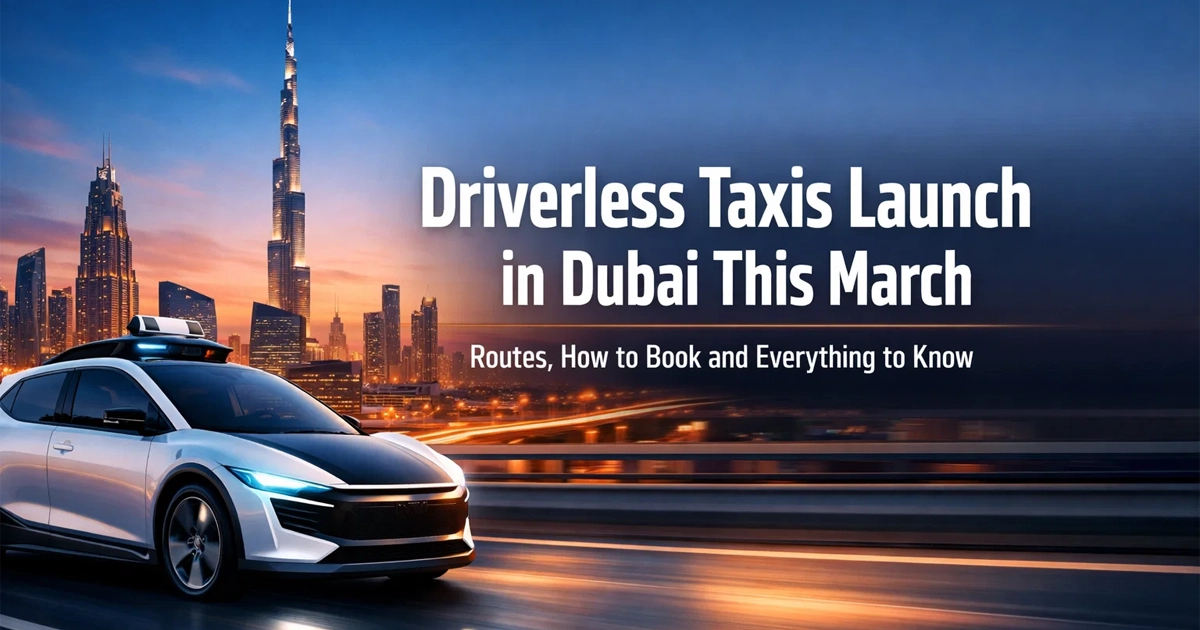
Dubai’s driverless taxi service goes public in March 2026. Operated by Baidu’s Apollo Go and WeRide in partnership with Uber and RTA, the fully autonomous taxis can be booked through the Uber app by choosing the ‘Autonomous’ option. Phase 1 covers Jumeirah and Umm Suqeim in 65 locations with 100 RT6 robotaxis deployed initially.
Dubai’s Driverless Taxis Era Starts
On 5 February 2026, Sheikh Hamdan bin Mohammed Al Maktoum, Crown Prince of Dubai, did something that would have been unimaginable a few years ago. He ditched his motorcade, hopped in a fully autonomous vehicle and took it for a ride to the World Governments Summit at Madinat Jumeirah – without a driver behind the wheel.
He posted the moment on X with the caption: “Hands off.” Future On. #SelfDrivingCar” – and with that the robotaxi era in Dubai was officially declared open.
On my way to the World Governments Summit 2026, I took a ride in a fully autonomous taxi, enabled by artificial intelligence, advanced sensing technologies, and autonomous decision-making systems. The future of mobility in Dubai will be smarter, safer, more efficient, and more… pic.twitter.com/p4xJFE0HS0
— Hamdan bin Mohammed (@HamdanMohammed) February 5, 2026
The public launch is confirmed by Dubai’s Roads and Transport Authority (RTA) to take place in Q1 2026 – this means that March is the window. This is not a pilot who has a back-up driver. These vehicles operate with no human in the driver’s seat, on actual Dubai roads in live traffic.
Who Is Behind Dubai’s Driverless Taxis?
Three global autonomous vehicle companies have been given permits by the RTA to operate in Dubai. Each of them brings a different vehicle and booking route:
| Company | Vehicle Model | How to Book | Operational Base |
| Baidu Apollo Go | RT6 (6th Gen Robotaxi) | Uber app + Apollo Go app | Jumeirah, Umm Suqeim, Sheikh Zayed Road |
| WeRide | WeRide GXR | Uber app (‘Autonomous’ option) | Umm Suqeim, Jumeirah |
| Pony.ai | TBD (trials ongoing) | TBD | Permit issued, routes TBC |
The headline act is Baidu’s Apollo Go, which opened its first international operations and control centre at Dubai Science Park – a 2,000 sq m facility that monitors every vehicle in real time, pushes software updates and runs safety simulations. This is also, notably, Apollo Go’s biggest international expansion outside China to date.
WeRide, which is listed on NASDAQ (WRD), was the first to provide public trial rides in Dubai, launching through the Uber app in December 2025 with a safety driver. WeRide and Uber also recently made their service in Abu Dhabi fully driverless – a template that the Dubai rollout now follows.
What Is the RT6 Robotaxi? Inside the Vehicle
The Baidu Apollo Go RT6 is a sixth-generation autonomous vehicle designed from scratch for commercial ride-hailing – that is, it has no steering wheel or pedals. It relies entirely on a sensor suite of over 40 components including high-precision LiDAR, multi-band radars and high-resolution cameras giving it 360-degree awareness of its surroundings.
The software employed by the vehicle combines real-time data, high-definition maps and deep learning algorithms and enables the vehicle to navigate through intersections, react to pedestrians and make immediate decisions safely – with no human interaction. Globally, Apollo Go vehicles have driven more than 150 million kilometres, and 10 million autonomous trips, laying the foundation that has arrived in Dubai.
The WeRide GXR, used in the Uber trial phase, is built on the SuperVAN platform from Geely’s Farizon brand – a spacious van-shaped vehicle designed for urban passenger transport.
How to Book a Driverless Taxi in Dubai
Booking is straightforward. If you are already using Uber, the process is almost the same as booking any other ride:
- Launch the Uber app on your phone
- Enter your destination
- Select “Autonomous” if it is available (this is only seen in the covered areas)
- Confirm your ride – The robotaxi picks you up without any driver in it.
- An operations team monitors each and every vehicle remotely from a control centre located in Dubai Science Park.
Alternatively, the Apollo Go rides can also be booked through the Apollo Go app itself.If you are booking an Uber Comfort or UberX in a covered zone you may also be automatically matched with an autonomous vehicle without manual selection.
Phase 1 Routes and Coverage Zones
The Phase 1 rollout covers 65 operational locations across the following primary zones:
| Zone | Key Landmarks Nearby | Status |
| Jumeirah | Jumeirah Beach, Jumeirah Mosque | Live – March 2026 |
| Umm Suqeim | Kite Beach, Burj Al Arab vicinity | Live – March 2026 |
| Sheikh Zayed Road corridor | Major business and hotel strip | Phase 1 expansion |
| Dubai Silicon Oasis | Tech hub, residential communities | Trials conducted, expansion planned |
Coverage will increase through 2026. The fleet is going from 100 vehicles to 1,000 over the next few years, and Dubai’s long-term goal is 4,000 autonomous taxis by 2030.
Traditional Taxi vs Driverless Taxi
| Feature | Traditional Taxi | Driverless Taxi (March 2026) |
| Driver | Human | Smart AI + 40+ sensors |
| Safety | Depends on driver | Reduces human-error accidents |
| Availability | Limited hours | 24/7 |
| Booking | App or street | Uber app – “Autonomous” option |
| Comfort | Good | Premium, quiet, smooth ride |
| Future Proof | Old style | Part of Dubai 2030 smart plan |
How Much Does a Driverless Taxi Cost in Dubai?
Official per-trip fares have not been published but pricing is expected to be closer to a 30% increase over a standard Dubai taxi – closer to the rates of a limousine taxi, not a regular one. Given that normal RTA taxi fares in Dubai starts from AED 12 flagfall, expect to see robotaxi rides to have a slight premium owing to the technology and experience. This pricing may change as the fleet grows. In China, the Apollo Go rides are priced in a competitive way with regular taxis, and similar trajectory is likely here as the volume increases.
Why Is Dubai Doing This? The Bigger Picture
This launch is not merely a tech display. It is at the heart of Dubai’s Self-Driving Transport Strategy, which is aimed at making 25% of all Dubai journeys autonomous by 2030. The numbers behind the strategy are compelling:
- Human error is responsible for more than 90% of traffic accidents – autonomous vehicles eliminate this variable completely.
- Dubai expects the strategy to bring AED 22 billion in economic value through savings in transport costs, fuel and productivity.
- AED 900 million predicted savings on transportation costs alone.
- AED 1.5 billion reduction in environmental pollution costs
The RTA’s head, Mattar Al Tayer, has positioned autonomous taxis as the key to first and last mile connectivity – the gap between people’s homes and Dubai Metro Blue Line stations. The service also is specifically designed to cater for the elderly, people of determination and those with limited mobility who may have problems using traditional transport options.
This fits into Dubai’s overall ambition to be a leader in global smart city development – from AI-powered traffic systems to AI noise radars on the roads to the longer term development of Al Maktoum International Airport as a global aviation hub.
The Bottom Line
Dubai has advanced more quickly on self-driving taxis than almost any city outside of China. With Baidu Apollo Go’s RT6 fleet live, WeRide’s GXR already proven in trials and Pony.ai permit in hand, March 2026 is the start of something that will reshape how millions of people move around this city.
If you are in Jumeirah or Umm Suqeim, open Uber, tap ‘Autonomous’ and take a ride into the future.
FAQs
Can anyone book driverless taxi in Dubai?
Yes. The service is available to all residents and visitors in Dubai. You need the Uber app or the Apollo Go app and you have to be in one of the covered zones (Jumeirah, Umm Suqeim or Sheikh Zayed Road corridor).
Is it safe? What happens if something goes wrong?
The RT6 carries over 40 sensors including LiDAR, Radar and High Resolution Cameras for complete 360 Degree Awareness. If the vehicle runs into a situation it cannot resolve, it safely pulls over and a remote operator from the Dubai Science Park control centre intervenes. Apollo Go has driven more than 150 million km of autonomous driving in the world before it reaches Dubai.
Is there a driver or safety operator in the car?
No. From the March 2026 public launch, these are fully driverless vehicles. The previous WeRide trial phase (December 2025) was done with a safety driver but for the commercial version the driver is completely removed.
How much does a robotaxi ride cost in Dubai?
Official fares are not yet publicly listed, but the service is expected to be priced around 30% above normal Dubai taxi fares – similar to a limousine cab. Pricing may become more competitive as the fleet scales up to 1,000 and then 4,000 vehicles by 2030.
Will this expand beyond Jumeirah and Umm Suqeim?
Yes. Phase 1 covers 65 locations in the first zones. Expansion to other neighbourhoods is planned in 2026, with a fleet goal of 1,000 vehicles in the near term and 4,000 by 2030.
